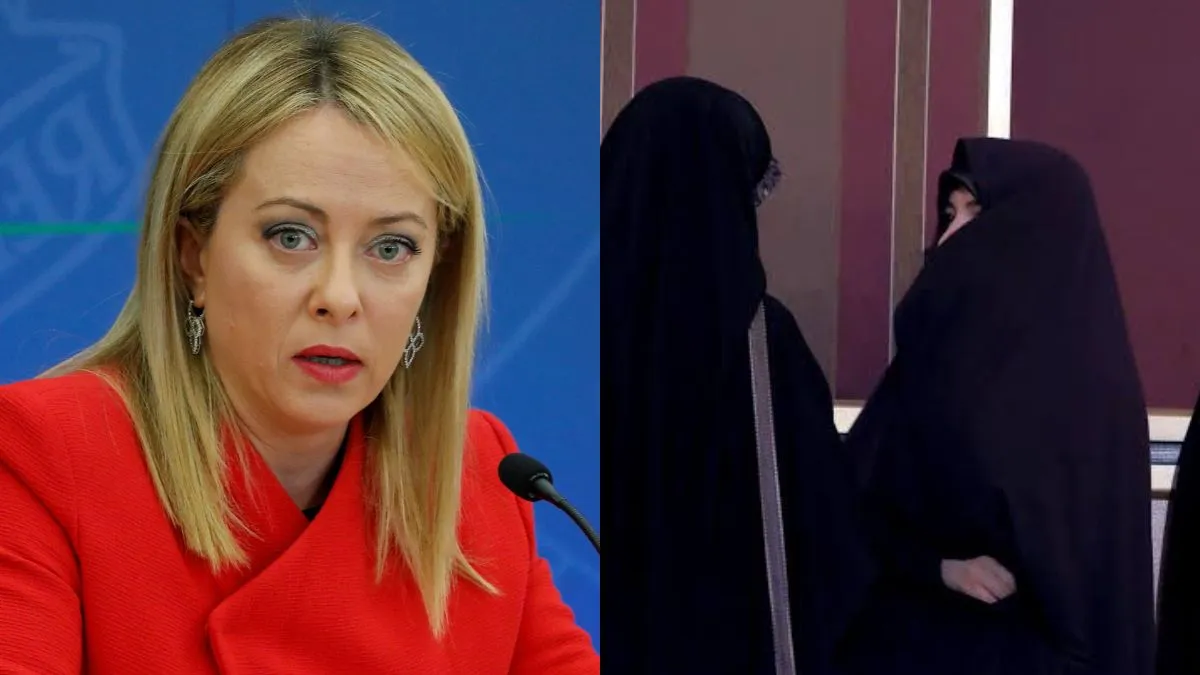
- Italy has approved law banning face coverings in schools.
- New legislation limits foreign students to 30% in classes.
- Violations of face covering rule incur fines up to 1,000 Euros.
Italy has become the latest European country to introduce restrictions on face-covering clothing, including the burqa and niqab in schools. The country’s parliament has given final approval to a new education law that prevents students from taking part in school activities if their faces are covered in a way that makes identification difficult. The law, which also introduces a limit on the number of certain foreign-origin students in first-year classrooms has sparked a political debate over religious freedom in Italy.
Italy Approves New Education Law
Italy's Chamber of Deputies gave final approval to the legislation on November 26. A total of 142 lawmakers voted in favour, 112 voted against it and four abstained. The Senate had already approved the measure on November 20. The new law covers more than religious clothing and includes changes to classroom arrangements, language education, digital textbooks, support for students with disabilities and teacher recruitment.
What Does The Face-Covering Rule Say?
One of its most debated provisions concerns clothing that covers the face. While the measure is being described as a ban on burqas and niqabs, its wording applies to face coverings that obstructs identification. Under the new legislation, students cannot participate in curricular or extracurricular school activities with their faces covered or concealed in a way that prevents identification.
Recommended For You
The rule is debated as it directly affects garments such as the niqab, which covers the face while leaving the eyes visible, and the burqa, which covers the entire body and face. Violations can attract fines of up to 1,000 Euros (approximately Rs 1,01,678). If the student is a minor, the fine will fall on their parents or legal guardians.
30 Per Cent Limit On Certain Foreign Students
Another major part of the law concerns the number of foreign-origin students in classrooms. The legislation introduces a 30 per cent limit for certain foreign students in first-year classes. The aim is to prevent too many students with limited knowledge of Italian from being placed in the same classroom. The government says the measure will help schools provide better education and make it easier for students to learn Italian.
The legislation has faced strong criticism from opposition parties, which argue that the government is targeting foreign families instead of dealing with the deeper problems in Italy's education system. During the parliamentary debate, opposition lawmakers displayed a message reading, "At school nobody is a foreigner", according to Euronews.
European Countries That Have Introduced Face-Covering Bans
Italy's decision comes amid a wider debate over the use of face-covering garments in public spaces in Europe. Several European countries have already introduced laws restricting clothing that conceals the face. However, these laws are not identical. Some apply across most public spaces, while others contain specific rules, exemptions, or different penalties.
France: France became one of the first European countries to introduce a nationwide public ban on full-face coverings in 2011.
Belgium: Belgium also introduced a nationwide restriction on face-covering clothing in 2011.
Bulgaria: Bulgaria introduced a nationwide restriction on face coverings in public in 2016.
Austria: Austria introduced its Anti-Face-Veiling Act in 2017.
Denmark: Denmark introduced a nationwide face-covering ban in 2018.
Switzerland: Switzerland introduced a nationwide ban on face coverings that came into effect on January 1, 2025.
You May Also Like To Watch: