
- By Shubham Bajpai
- Wed, 15 Apr 2026 08:36 PM (IST)
- Source:JND
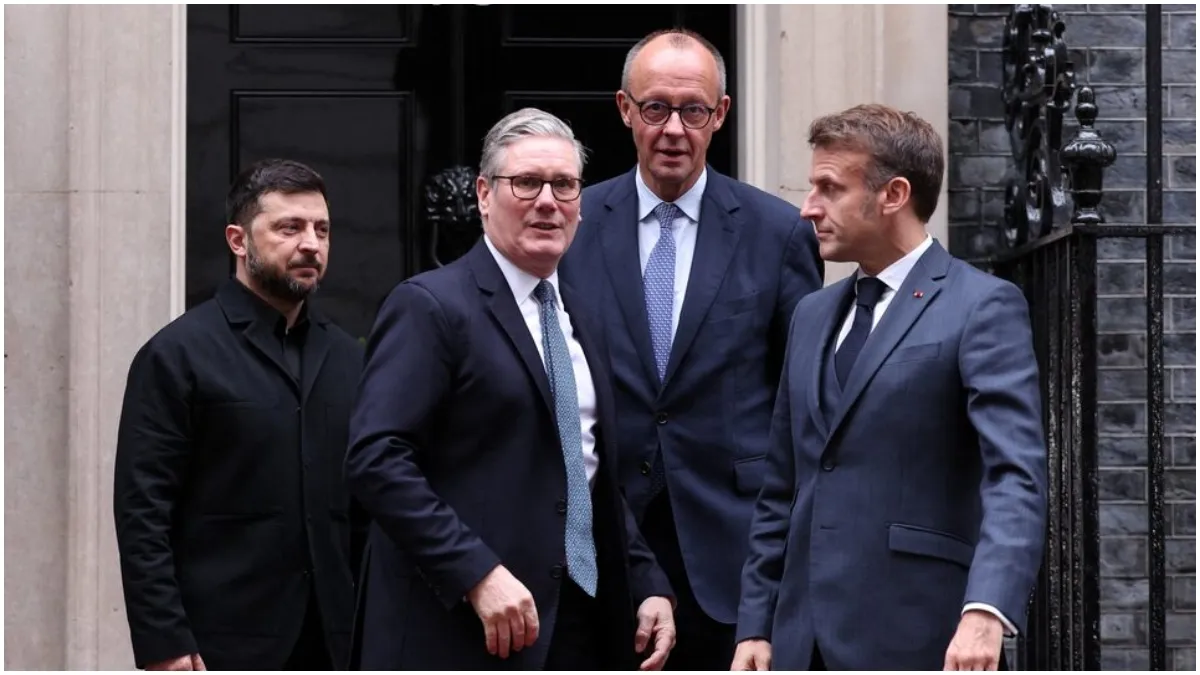
The differences between the United States and its European partners are growing over the ongoing tensions in West Asia as the latter have consistently steered clear of the conflict despite US President Donald Trump's repeated calls and claims. Instead of being drawn into the US' war against Iran, European countries, like Britain and France, are looking to emerge as a stabilising force in the region.
A Wall Street Journal report suggests that European nations are working on a proposal to form an international coalition to free the Strait of Hormuz but only after the war ends. The proposal excludes the United States' involvement in the post-war efforts.
The report cited French President Emmanuel Macron saying that the idea behind the proposal is to establish a defensive international mission excluding "belligerent" parties, the US, Israel and Iran.
What does Europe's plan offer?
The European countries are planning a naval deployment in the post-war Persian Gulf devoid of the American command, working independently. The mission will deploy mine-clearing and other naval assets to secure the Strait of Hormuz.
ALSO READ: Trump Claims China Is ‘Happy’ Over US' Hormuz Blockade, Hints At Cooperation On Iran Issue
The move is aimed at providing confidence to shipping companies to use the route once the war ends, effectively improving global energy security rapidly.
European countries have grown concerned over the economic fallout if the closure of the Strait lasts long.
Europe pivoting away from US?
Trump-Zelensky Oval Office Meet: Europe has grown distant from the United States since Trump assumed office. Last year's Trump-Zelensky Oval Office meeting, where the US President and VP JD Vance engaged in a verbal spat with the Ukrainian President over ending the war with Russia, prompted the European nations to rally behind Zelensky.
Countries like Germany, Italy, France and NATO later joined the August meeting between Trump and Zelensky as "Bodyguard" support.
Greenland and tariffs: Later in the same year, Trump threatened to impose 10-25 per cent tariffs on goods from Denmark, Finland, France, Germany, the Netherlands, Norway, Sweden and the UK, following his demand to acquire Greenland. Europe slammed these moves as undermining the transatlantic relationship. Macron had labelled them "unacceptable". The trade and tariff dispute ultimately led to the suspension of the approval of a key US trade deal scheduled for 2026.
ALSO READ: 'Commander In Grief': Iran Mocks Trump Over Fallout With Meloni, Offers ‘Ally’ Pitch to Italy
Iran War: 2026 started no differently, as since the start of the Iran war on February 28, European countries have denied being drawn into the conflict. Trump had openly asked the European allies to join forces to free up the Strait, a demand that was categorically denied by UK PM Kier Starmer and other leaders of the nations.
Trump also reiterated his demand under the NATO framework only to be denied again, causing him to call the alliance a 'paper tiger.' Later on April 12, when the Islamabad peace talks between Tehran and Washington failed, Trump announced a naval blockade of the Strait, claiming that NATO was ready to help the US. He claimed Britain and other nations would be sending minesweepers.
However, Starmer and Macron were quick to reject the claim. Apart from the UK and France, the US ties with Spain have also strained as the Spanish PM openly criticised Trump's war on Iran. On the other hand, Italy on Tuesday scrapped a 2006 defence deal with Israel, hinting a change in stance over military tie ups.