

- By Raju Kumar
- Wed, 10 Jun 2026 05:14 PM (IST)
- Source:JND
Modi Govt 12 Years: Prime Minister Narendra Modi on Wednesday became the country's longest-serving elected premier, completing 12 years in power at the Centre. PM Modi, who led the National Democratic Alliance government, completed 4,399 days as Prime Minister on June 10. PM Modi surpassed India's first Prime Minister, Jawaharlal Nehru, who originally assumed office in 1947 and won the country's first general election in 1951-52. He remained in office until his passing in 1964.
PM Modi, who assumed office on May 26, 2014, following the NDA's victory in the Lok Sabha elections, made several bold and visionary decisions that helped transform almost every sector, including the economy.
From inclusion to integration
— PIB India (@PIB_India) June 10, 2026
One leader.
4,399 days.
Four defining milestones. #LongestServingElectedPMModi pic.twitter.com/rAI41qmAQ8
Here Is List Of 12 Major Achievements Of The Modi Government:
1. Ram Mandir: The construction of the Ram Temple, following the landmark Supreme Court verdict in 2019, marked the end of a centuries-old dispute. It is one of the biggest achievements of the Modi government. Perhaps no issue held greater symbolic significance for the BJP than the Ram Janmabhoomi movement.
2. Article 370: On August 5, 2019, the Modi government abolished the special constitutional status of Jammu and Kashmir under Article 370. This decision fulfilled the BJP's long-standing ideological commitment and was one of the boldest political moves of the Modi government.
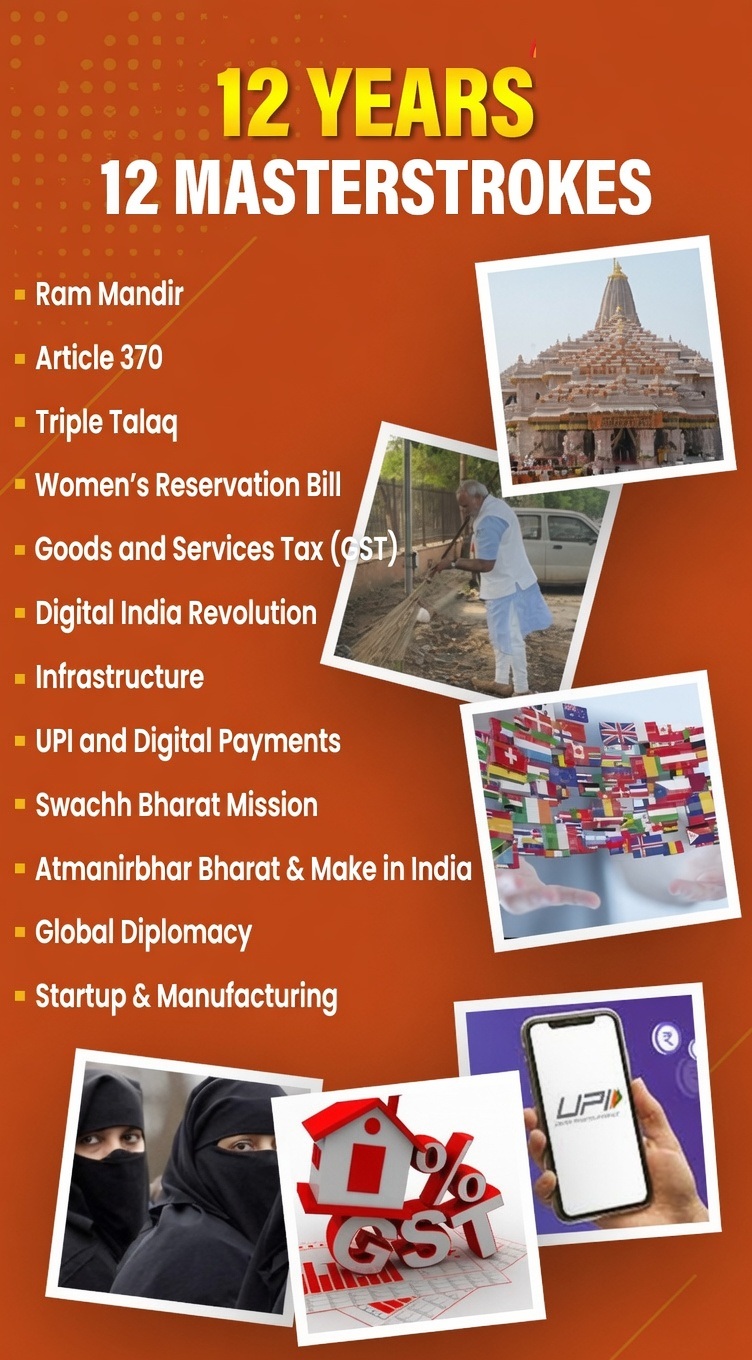
3. UPI Payment: The Unified Payments Interface is a prime example of India's digital transformation. The Modi government launched the Unified Payments Interface (UPI) project on April 11, 2016, which has today become the backbone of India's retail economy.
4. Women's Reservation Bill: The Modi government enacted the Women's Reservation Act, the 106th Constitutional Amendment (Nari Shakti Vandan Adhiniyam), reserving 33 per cent of seats for women in the Lok Sabha and state legislative assemblies. The move is seen as a landmark step in the direction of women's empowerment in politics.
5. GST: The Goods and Services Tax (GST), implemented in July 2017, introduced a single indirect tax structure, eliminating the complex web of state and central taxes. This reform had been pending for many years, but the Modi government was successful in implementing it. GST created a unified national market and became one of India's biggest tax reforms since independence.
6. Startup India: When the Modi government launched Startup India in 2016, India's startup ecosystem was in its nascent stages. A decade later, India is home to one of the world's largest startup ecosystems, with thousands of recognised startups operating in sectors such as fintech, e-commerce, artificial intelligence, and deep technology. Now, India has over 2.23 lakh recognised startups as of March 31, 2026.
7. Make In India Project: Manufacturing and self-reliance became central themes of Modi's economic vision. The Make in India initiative sought to transform the country into a manufacturing hub, while Atmanirbhar Bharat gained momentum during the COVID-19 pandemic. The government emphasised domestic production, supply-chain resilience, and strategic self-reliance. These programs helped attract investment in sectors ranging from electronics and defence to semiconductors.
8. Triple Talaq: In 2019, the Modi government passed a law - The Muslim Women (Protection of Rights on Marriage) Act - in the Parliament, criminalising instant triple talaq. The government hailed the move as a historic step toward gender justice and women's empowerment, arguing that it provided Muslim women with legal protection against arbitrary divorce practices.
9. JAM Trinity: The Jan Dhan-Aadhaar-Mobile (JAM) architecture has fundamentally transformed the way welfare benefits reach citizens. By linking bank accounts, biometric identification, and mobile connectivity, the government reduced leakages in subsidy distribution and enabled direct benefit transfers on an unprecedented scale. This model has since become a global case study in digital governance.10
10. Infrastructure: India has witnessed rapid development in highways, expressways, railway modernisation, airports, metro networks, and rural road connectivity, especially in remote areas that once lacked roads and electricity. India is also set to get its first bullet train project, the Mumbai-Ahmedabad High-Speed Rail (MAHSR) corridor. The Rs 1.1 lakh crore project is on track for a partial launch in August 2027.
11. Global Diplomacy: India has significantly strengthened its global presence through active diplomacy, strong international partnerships, and a leadership role in forums such as the G20. India redefined its relations with the Gulf countries. During 'Operation Sindoor', the government exposed Pakistan's real face in the world.
12. Swachh Bharat Mission: The Swachh Bharat Mission is a nationwide sanitation campaign initiated by the Modi government on October 2, 2014. Under the Swachh Bharat Mission, 12 crore toilets have been built, cutting open defecation and marking a major stride in public health and sanitation.
(With Agencies Inputs)